


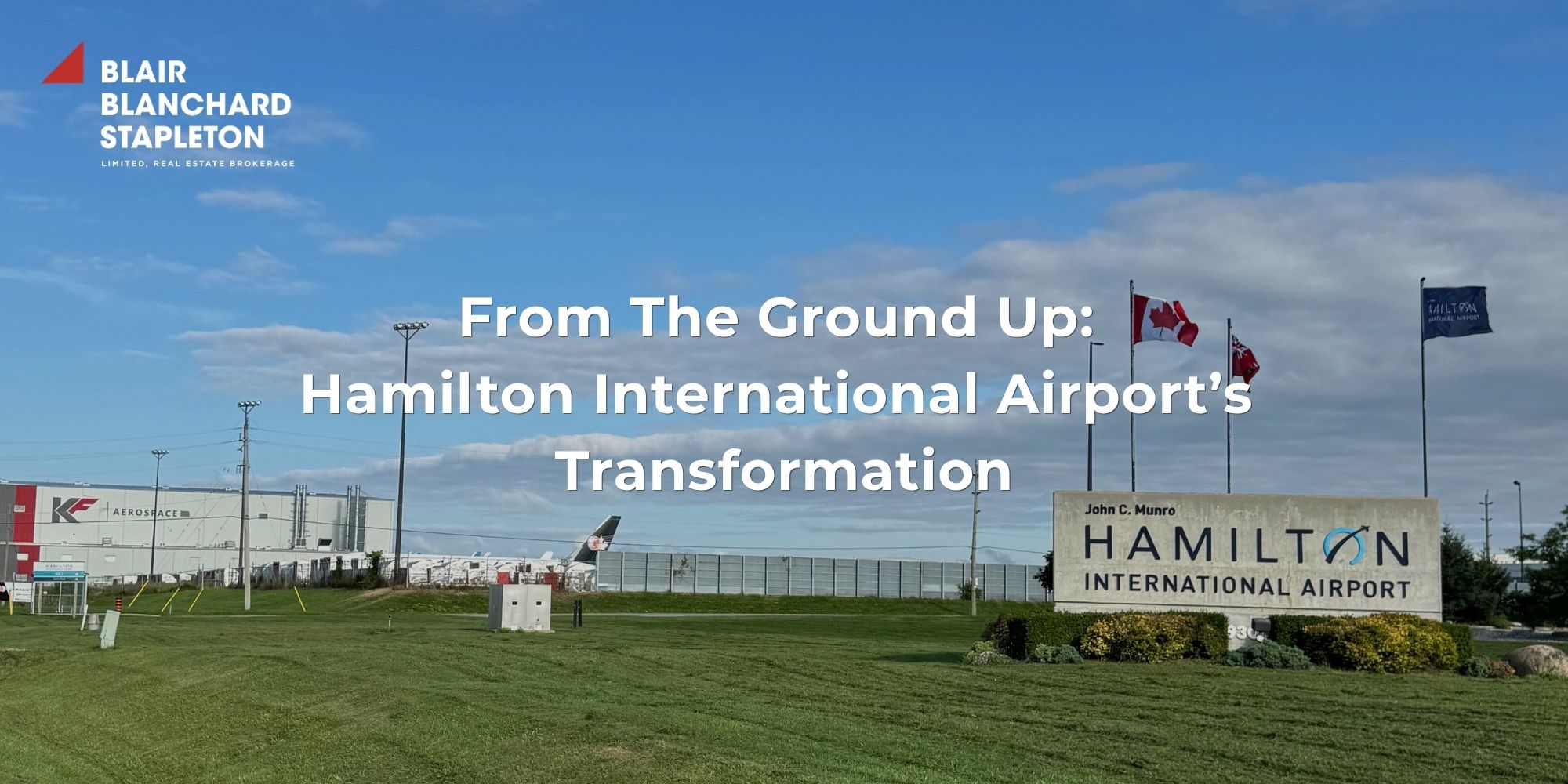
September 25, 2026 | Over the past year, the area surrounding John C. Munro Hamilton International Airport (YHM) has been home to some exciting developments which have reinforced the region as a logistics and transit hub with substantial infrastructure investment, aviation service growth, and planning progress.
Key developments include:
Major terminal upgrades by TradePort International, including Hamilton’s first passenger jet bridges, a refreshed facade, a modern interior layout, and improved border-processing readiness.
Porter Airlines launching daily service from Hamilton to key western and eastern Canadian markets such as Calgary, Edmonton, Halifax, and Vancouver, expanding travel options and supporting local hospitality demand.
Latitude Air Ambulance opening a new 44,000 sf hangar, and Biddle Carson Developments construction of a 100,000 square foot Fixed Base Operator facility, signaling that aviation-adjacent infrastructure demand is continuing to build.
DHL Express’s quadrupling its previous footprint with a one hundred million dollar, 200,000 square foot automated gateway hub expansion, solidifying long-term e-commerce distribution channels.
Hamilton’s airport momentum is also reinforced through long term planning and transportation initiatives including:
The City of Hamilton and TradePort finalizing a historic 49 year, $400 million master deal focused on long range cargo enhancements, taxiway modernization, and a path toward net-zero carbon by 2030.
The City of Hamilton initiating a Municipal Class Environmental Assessment to evaluate a dedicated transit link connecting Highway 6 South with the Red Hill Business Park, aiming to improve how goods move efficiently from the airport employment zones into the broader highway network.
The City of Hamilton supporting development around the airport by launching an update to the Airport Employment Growth District (AEGD) Secondary Plan, designed to organize and fast-track eco-business park development across 555 hectares surrounding YHM while ensuring seamless logistics and transit connectivity.
Together, these changes help translate airport growth into broader outcomes.
YHM’s continued strength as Canada’s largest express overnight cargo hub supports sustained demand from logistics, e-commerce, and warehousing operators seeking locations with practical airside access. That demand can influence nearby submarkets as more industrial and build-to-suit projects expand beyond the immediate airport footprint, helping increase total commercial inventory across the Hamilton region.
Increased investor interest is also a factor, since 24/7 runway capability combined with Hamilton’s Foreign Trade Zone (FTZ) status can create added operational value for international companies considering expansion. Finally, the airport ecosystem’s employment impact boasts over 4,500 direct local jobs and supports demand not only for industrial space, but also for nearby office and hospitality uses as travel and business activity increase.
The broader takeaway? When airport upgrades, air service growth, and regional planning move together, Hamilton tends to benefit as a whole. As for the commercial real estate market near the airport and throughout surrounding areas, these exciting developments can translate into a stronger pipeline, increased tenant attraction, and greater confidence in where demand is heading next.
For more information please visit the following websites:
John C. Munroe Hamilton International Airport – Business & Corporate:
https://business.flyhamilton.ca/
John C. Munroe Hamilton International Airport – Public:
Engage Hamilton – Airport Conceptual Link (Hwy 6 & Red Hill Business Park):
https://engage.hamilton.ca/airportconceptuallinkstudy
John C. Munroe Hamilton International Airport – Hamilton Foreign Trade Zone (FTZ):
https://business.flyhamilton.ca/ftz/
City of Hamilton – Airport Employment Growth District Secondary Plan:
For all of your commercial real estate needs reach out to us at 905-529-5900!
